Miles to go
CRL
Charleroi
BRI
Bari
Puglia
Trulli, cliffs and whitewashed towns, over a weekend
Flight
2h15
Occasion
A wedding
Date
Sept. 2023

In September 2023, for friends' wedding in Puglia, we had the chance to discover a small part of this beautiful region — the heel of Italy's boot. A 2h15 Ryanair flight from Charleroi, then on to the Masseria Narducci, about an hour's drive from Bari airport, with a hire car for the weekend. A short stay, but enough to see a few lovely towns.

✓ Visited in September 2023
✎ A masseria is a former fortified farmhouse, typical of Puglia, built around a courtyard and often surrounded by olive groves. Many have been converted into hotels or guesthouses: it's the most local way to sleep in the region, and often cheaper than the coast.

01Alberobello

"The capital of the Trulli", tucked inland in the Itria Valley — a UNESCO World Heritage Site since 1996. Trulli are small round dry-stone houses coated in whitewash, topped with a conical roof often bearing a painted symbol.

✎ Why no mortar? The story goes that these houses were built from stones simply stacked so they could be taken apart in a hurry. The Kingdom of Naples taxed new buildings at the time: word of an inspection, out came the keystone, down came the roof, and all that was left to declare was a pile of rubble. The symbols whitewashed onto the roofs — crosses, hearts, zodiac signs — are by turns religious, pagan and superstitious.

The town has two quarters worth visiting: Rione Monti, the larger and more commercial, with close to a thousand trulli, and Aia Piccola, smaller and still lived in — where you best feel the life of the village.

There are several car parks; we parked free at the entrance to the town, at Parco Viale Bari.
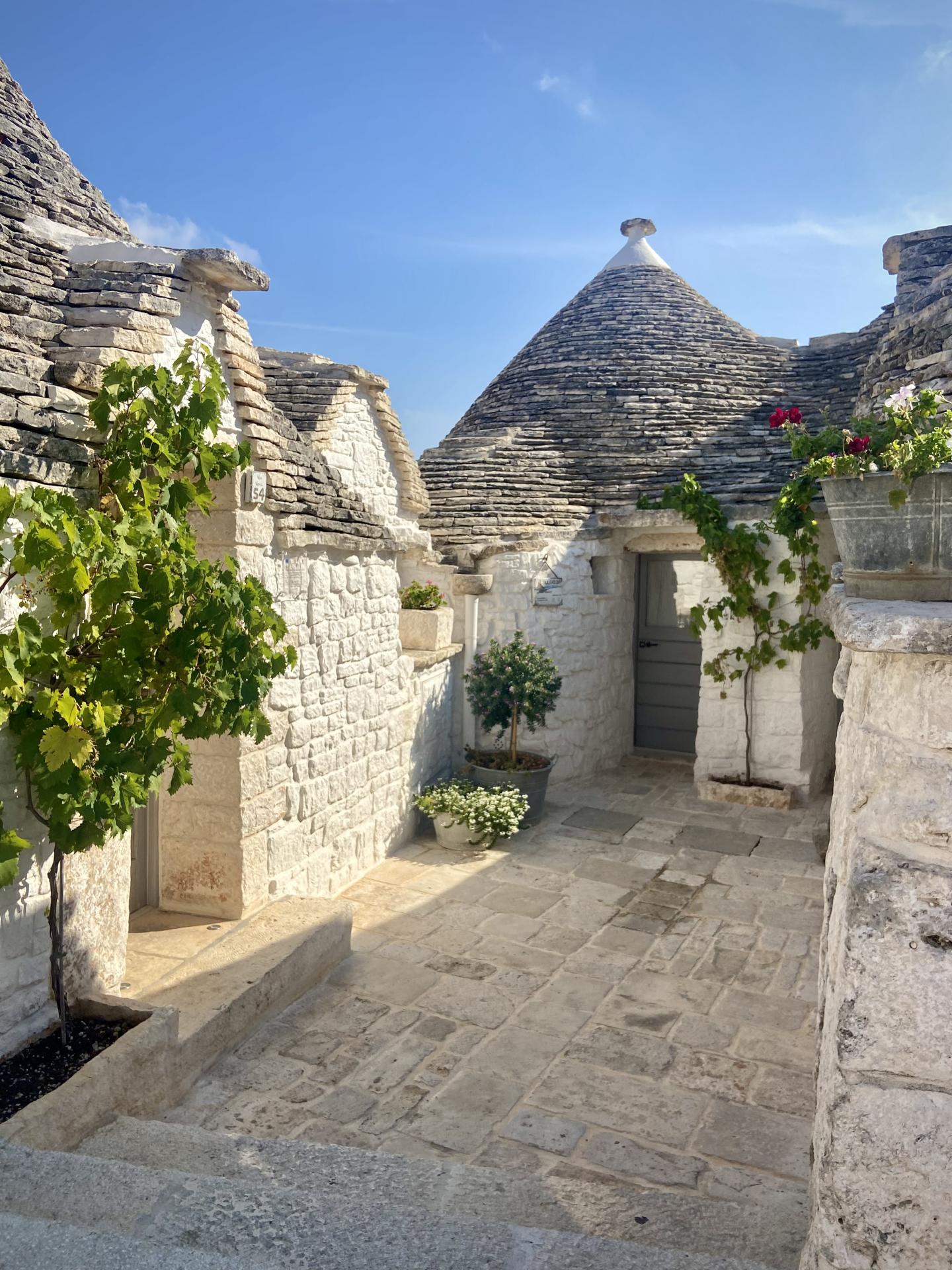
✎ Alberobello is overrun by coach parties in the middle of the day. Come early morning or late afternoon: the lanes empty out, and the light on the whitewash is far better.
Alberobello
Alberobello
The trulli of Alberobello
Trulli

02Polignano a Mare

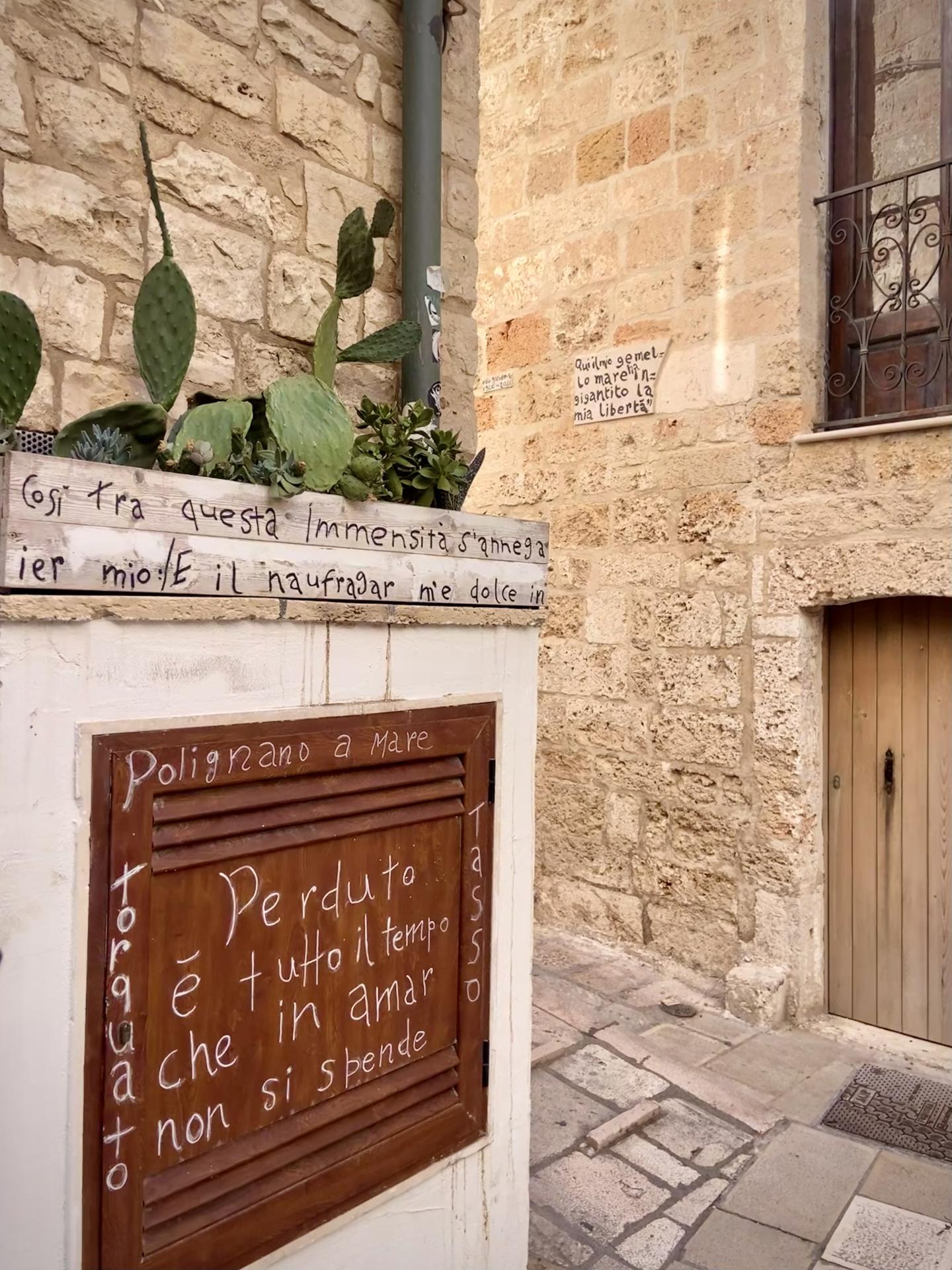
Nicknamed "the Pearl of the Adriatic", built on limestone cliffs — a breathtaking setting of turquoise sea, caves and sheer drops. Not to be missed: Piazza dell'Orologio, the Matrice di Santa Maria Assunta church, the beach at Lama Monachile, wedged between two walls of rock, and its caves. Viewpoints over the cliffs open up all through the old town.

✎ This is the birthplace of Domenico Modugno, who wrote Nel blu, dipinto di blu — the song the world knows as Volare. His statue, arms flung open to the sea, stands on the seafront: one of the most photographed spots in town.
✎ Those same cliffs regularly host a round of the cliff diving world series: divers launch from a platform rigged above the houses, 27 metres over the Lama Monachile cove.
Polignano a Mare
Polignano a Mare
Polignano a Mare
Polignano a Mare
The cliffs of Polignano a Mare
Polignano a Mare

03Monopoli

Less busy than the bigger towns, but well worth the detour — nicknamed "the Jewel of Puglia". The Centro Storico, with its narrow, picturesque lanes, doesn't allow a bad photograph. Along the way: the Castello Carlo V, a 16th-century fortress built under the emperor Charles V, and the basilica of Santa Maria della Madia. Impossible to miss the Porto Antico too, where the traditional red and blue boats, the gozzi, are moored.

Monopoli
Monopoli
The Porto Antico in Monopoli
Monopoli

+The hire car trap

Puglia is a region you see by car — the towns are far apart and poorly connected. But watch out for a classic Italian trap.

✎ ZTL, or limited traffic zones. Most Italian historic centres are closed to unauthorised vehicles, with cameras at the entrances. Nothing stops you on the spot: the fine arrives by post months later, with the rental company's admin fee on top. Look for the round signs with a red border marked "ZTL", and always park outside the centre, as we did in Alberobello.
✎ Parking bays are colour-coded: white lines mean free, blue means paid — buy a ticket from the machine — and yellow means reserved, to be avoided at all costs.

+If you stay longer

Our weekend only allowed us to see a small part of the region. Within an hour's drive at most, four stops that round out this route:

Ostuni
The white town
A wholly whitewashed town set on a hill facing the Adriatic, in a sea of olive trees.
Locorotondo & Cisternino
Itria Valley
Two villages next to Alberobello, far quieter, and every bit as pretty.
Lecce
≈ 1h30 from Monopoli
Nicknamed the "Florence of the South" for its golden-stone baroque. The finest city in Puglia.
Matera
Basilicata · ≈ 1h from Alberobello
Technically in the neighbouring region, but far too close to ignore: its Sassi, districts of dwellings carved into the rock, are UNESCO-listed and among the oldest continuously inhabited places on earth.

+Good to know

When to go
May-June and September-October are ideal: warm without being punishing, and without the summer crowds. In July and August it regularly passes 35°C and the coast is packed.
The afternoon break
Many shops close between 1pm and 4:30pm. Plan your sightseeing for the morning and late afternoon, with lunch in between.
What to eat
Orecchiette, the little ear-shaped pasta, burrata — born in Andria, in this very region — and focaccia barese, with tomato and olives.
My verdict · after a weekend
★
My favourite: Alberobello
  • Those extraordinary white houses have a charm that's hard to put into words
  • But it's very, very touristy: if you don't arrive early in the day, it's full
✓
How long to stay
  • A weekend is too short
  • Allow a long weekend at the very least, and ideally a week to see the region properly
✎
Staying in a masseria
  • An incredible experience: we felt included, steeped in the local culture
  • And a kindness that made this wedding a beautiful one

+Read next
★ ★ ★ ★ ★
No ratings yet - be the first to rate this.

Add a comment

Anti-spam